
How Dallas Foundation Shifts Impact Your Windows & Need Repair
If you own a home or commercial property in the Dallas–Fort Worth metroplex, you are living on one of the most geologically active urban landscapes in the entire country, not because of earthquakes, but because of soil. The expansive black clay that underlies most of the DFW basin absorbs water like a sponge each spring and then contracts dramatically during the long, dry Texas summers. This relentless cycle of swelling and shrinking pushes your foundation up, pulls it down, and twists it sideways in ways that are almost invisible at first, until your windows start telling the story. Sticking sashes, cracked glazing, and drafty gaps are all signs that the ground beneath you has moved and your window frames have moved with it. That is precisely why professional window repair Dallas services exist: to diagnose and correct foundation-driven window damage before it escalates into a full replacement project costing thousands of dollars. In this guide, we break down the science, the symptoms, and the smartest path to protecting your investment.
Understanding Why You Need Window Repair Dallas Due to Soil Movement
Dallas sits on what geologists call the Blackland Prairie, a belt of Houston Black clay soil that stretches from the Red River down through Central Texas. This clay is classified as a shrink-swell soil because its volume changes dramatically depending on its moisture content. During a wet winter or spring, the clay absorbs water and can expand by as much as 30 to 40 percent in volume. When summer arrives and rainfall disappears, that same clay dries out and contracts back, pulling away from itself and leaving gaps in the ground that are sometimes visible as cracks in your yard or along your driveway.
What does any of this have to do with your windows? Everything. Your home's foundation is anchored to this soil. As the soil heaves upward in wet months and then drops in dry months, different sections of your slab or pier-and-beam foundation move at different rates depending on how much moisture that particular area of ground has retained. This uneven movement, called differential settlement, racks the entire structural frame of your house out of square. Wall studs that were once perfectly plumb lean slightly. Door headers shift. And window rough openings, the rectangular holes cut into your wall framing that are supposed to hold your window units perfectly level and plumb, go slightly out of true. The window unit itself, whether vinyl, wood, or aluminum, then binds inside that distorted opening. Understanding this mechanics chain is the first step to appreciating why reactive window repair Dallas work is not a luxury but a genuine structural necessity for DFW homeowners.
It is also worth noting that Dallas's extreme temperature swings compound the problem. Summer high temperatures regularly exceed 100°F, while winter cold snaps can drop below 20°F. This thermal cycling causes window frames and glass to expand and contract independent of any soil movement. When you layer soil-driven foundation shifts on top of thermal expansion, the cumulative stress on caulk seals, glazing compounds, and weatherstripping is substantial.
How Foundation Issues Trigger Window Repair Dallas Needs
Most homeowners do not realize their windows are sending distress signals about the foundation until the symptoms become severe. Here are the most common signs that foundation movement has created a window repair Dallas situation that warrants a professional evaluation:
- Sashes that stick or refuse to latch: When a window opening racks even a fraction of an inch out of square, the sash no longer travels smoothly in its track. You may notice that a window which once slid effortlessly now requires significant force to open, or that the latch no longer aligns with the strike plate. This is a direct result of the rough opening changing shape.
- Diagonal cracks radiating from window corners: Drywall and plaster follow the framing. When the wall frame deforms, the finish material cracks along lines of stress. The classic pattern is a diagonal crack running at roughly 45 degrees from the upper corner of a window opening toward the ceiling. If you see this crack appearing or growing, the underlying cause is almost certainly foundation movement.
- Visible gaps between the window frame and the wall: As the rough opening shifts, the window unit may pull away from the surrounding drywall or brick mold on one side, creating a visible gap. This gap allows conditioned air to escape, moisture to infiltrate, and insects to enter.
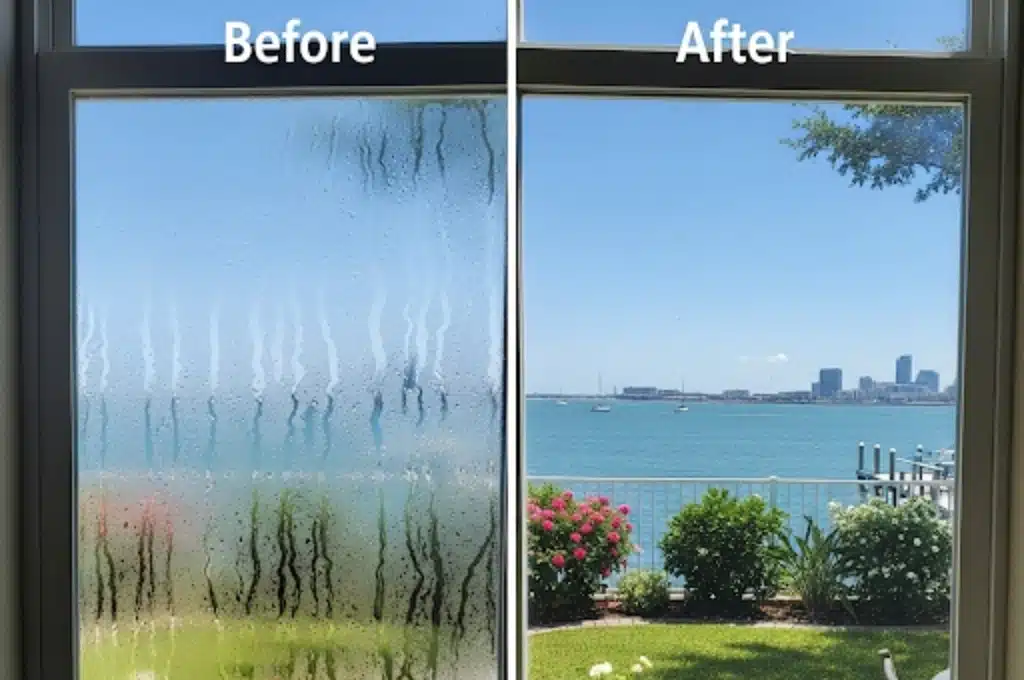
- Broken or fogged insulated glass units: When a frame is torqued by foundation pressure, it can stress the corners of the insulated glass unit (IGU) inside the sash. This stress fractures the glass seal, causing the inert argon gas to escape and humid air to enter the void between the panes, producing that characteristic foggy appearance.
- Drafts and higher energy bills: Compression and racking damage the perimeter weatherstripping seal. You may feel cold air infiltrating around your windows in winter even though you recently replaced the weatherstripping. Foundation movement is often the culprit that keeps breaking that seal.
Any one of these symptoms on its own might have a benign explanation. But if you are seeing two or more of these signs simultaneously, particularly if they appeared or worsened after a stretch of extremely dry or wet weather, you should strongly consider having both a foundation specialist and a window repair professional evaluate your property.
If your windows are difficult to open, don't force them. Foundation-related pressure can shatter glass or permanently warp the frame if forced. Call a qualified window repair professional first to assess whether the opening needs to be relieved before the sash is operated.
Table: Repairing Window Frames vs. Full Replacement
One of the most common questions we hear from Dallas homeowners is whether they should repair their foundation-damaged windows or replace them entirely. The honest answer depends on the severity of the structural distortion, the condition of the existing window unit, and the realistic cost-benefit of each path. The table below summarizes how we assess each scenario.
| Issue Type | Repair Feasibility | Dallas Average Cost |
|---|---|---|
| Minor Frame Binding | High | $150 – $300 |
| Structural Cracks | Medium | $300 – $600 |
| Sill / Header Warpage | Low | $600+ |
Minor frame binding is by far the most common presentation and also the most straightforward to address. In most cases, a technician will shim the frame back into square, adjust the sash hardware, and re-seal the perimeter , all completed in a single visit. Structural cracks in the rough opening framing or surrounding masonry require more invasive work: sistering new studs alongside damaged ones, re-flashing the sill, and sometimes replacing portions of the window unit itself. Sill and header warpage is the most serious category, often indicating that the rough opening has moved so significantly that the framing lumber has permanently deformed. At this stage, the opening typically needs to be rebuilt and a new window unit installed.
What is critical to understand is that none of these repairs will hold long-term unless the foundation movement causing them is also addressed or at least stabilized. We always recommend that Dallas homeowners work in parallel with a licensed foundation repair contractor when window issues are clearly structural in origin. Our window repairs are designed to accommodate the realistic ongoing movement of a DFW slab, using flexible sealants and hardware tolerances appropriate for this climate, but they are most effective when the root-cause soil issues are also being managed.
Seasonal Window Maintenance for Dallas Homeowners
Prevention is always cheaper than repair. Given Dallas's extreme seasonal swings, there are a handful of maintenance habits that can dramatically reduce the frequency and severity of foundation-driven window damage over the life of your home.
Maintain consistent soil moisture around your foundation. The single most damaging thing you can do to a Dallas slab is allow the soil immediately adjacent to it to dry out completely during summer. Foundation engineers routinely recommend running a soaker hose about 18 inches from the perimeter of your foundation during drought conditions to keep the soil moisture level stable. Consistent moisture means less dramatic shrink-swell cycling, which means less differential movement, which means your windows stay in square longer.
Inspect and re-caulk every spring and fall. Twice a year, walk the exterior of your home and probe the caulk bead where your window frames meet the exterior wall cladding. Dallas's UV intensity and temperature extremes degrade exterior caulk quickly. Any caulk that is cracked, brittle, or pulling away should be removed and replaced with a high-quality, paintable elastomeric caulk rated for at least 50-year durability. This simple step prevents water infiltration that would otherwise migrate into your wall cavity and accelerate wood rot in the rough opening framing.
Service your window hardware annually. Hinges, balances, and locking mechanisms all benefit from annual lubrication and adjustment. Well-maintained hardware can accommodate the minor seasonal movement that even a stable Dallas foundation will produce, whereas neglected hardware will bind and fail when that movement occurs.
Why Choosing a Dallas-Based Window Repair Specialist Matters
Not every window repair company has experience working in the DFW clay soil environment. Contractors who are accustomed to building in Houston's slightly different geology, or who trained in the Midwest where soils behave entirely differently, may apply techniques and products that are not suited to the particular demands of a Dallas clay-expansion situation. Shimming a window frame with non-compressible rigid materials, for example, may solve the immediate binding problem but will cause the frame or surrounding drywall to crack when the soil heaves again next spring.
Local expertise means understanding that Dallas window repair is not a one-time, static fix, it is an ongoing management of a dynamic system. Our team at Windows & Doors Repair LLC has spent years working specifically in the neighborhoods that sit on the heaviest clay deposits: Preston Hollow, Lake Highlands, Lakewood, Oak Cliff, and the older mid-century neighborhoods of Garland and Richardson. We know which building vintages are most susceptible to racking, which window types hold up best under cyclic foundation stress, and which repair techniques provide durable results in this specific climate.
If your windows are showing any of the symptoms described in this guide, do not wait for the problem to worsen through another Texas summer or a wet La Niña winter. The window is almost always easier and less expensive to save when addressed early. Contact our team for a free, no-obligation on-site evaluation and let us give you an honest assessment of what your windows need, and what they don't.